Brocken Spectre: The Rings Center on Your Own Shadow’s Head
The Reading Room Published
Short answer
A Brocken spectre is your shadow on cloud or fog below, usually from a low Sun. Any colored rings around it, a glory, center on the antisolar point, the shadow of your own head.
Viewing card
- Where
- On cloud or fog lying below the viewer: from a summit or ridge above valley fog, or from an aircraft above a cloud deck
- Seen from
- The viewer's own position, looking down and away from the Sun, usually with the Sun low at the viewer's back
- Captured
- Engraving: fig. 84 of Camille Flammarion's L'atmosphère (Paris, 1888); photograph: Adrian Pingstone, from an aircraft over France, 1968
- Reading altitude
- In the sky: back to the Sun, usually a low Sun from a summit or ridge, looking down onto cloud or fog at the shadow of the viewer's own head, where the line from the Sun through that head meets the cloud
- Written by
- Sunlight from behind the viewer throws the viewer's shadow onto the cloud; droplets in a water cloud can ring that shadow's head with faint color, centered where the line from the Sun through the viewer's head meets the cloud
This card as data (CSV) About this file
Data: Sources named in the card: AMS Glossary of Meteorology (Brocken spectre, glory, antisolar point), retrieved 2026-11-16
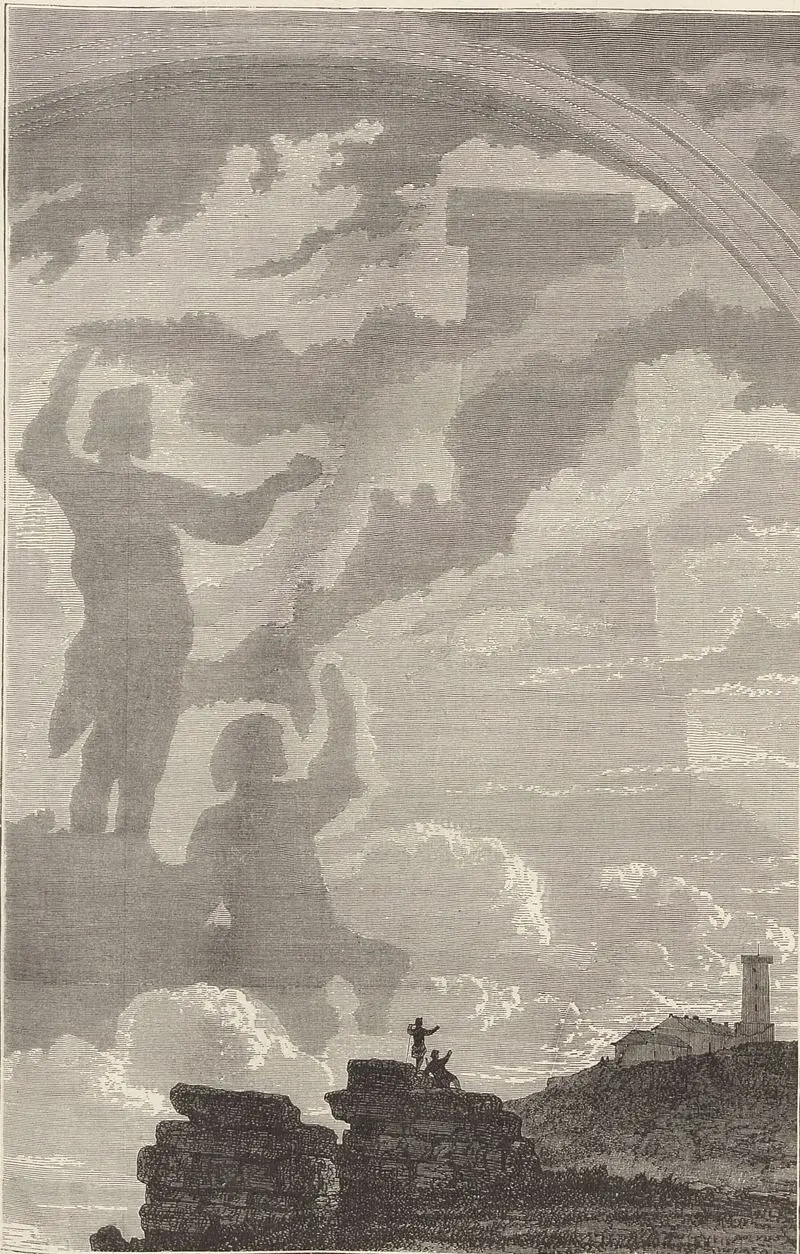
Figure 84 of Camille Flammarion's L'atmosphère (1888) draws two giant shadows on the cloud above the people who cast them. The print shows no small rings around either head.
"Le Spectre du Brocken, fig. 84, from L'atmosphère: météorologie populaire" by Unknown author — https://commons.wikimedia.org/wiki/File:Flammarion_Le_Spectre_du_Brocken_.jpg — Public domain (US: first published 1888, before 1931; EU: anonymous engraving first published 1888, more than 70 years ago (engraver not named)); modified: resized
With the Sun low behind you and mist below, a huge shadow of you can appear on the cloud. Faint colored rings may circle its head, and a friend standing beside you sees rings centered on a different head: their own. The American Meteorological Society's Glossary of Meteorology names the shadow a Brocken spectre and the rings a glory. Both follow from where the Sun sits behind the viewer.
What is a Brocken spectre?
The AMS Glossary entry for Brocken spectre defines it as a viewer's shadow thrown onto a cloud. It usually happens on a mountain top or ridge, when a low Sun casts the shadow onto fog or cloud in the valley below. The same entry traces the name to early sightings by climbers on the Brocken, a peak in Germany's Harz Mountains. Mountain viewpoints frame other sky readings too, such as lenticular clouds.
The colored rings are a separate effect with a name of their own. The AMS Glossary entry for glory describes faint rings of color around the antisolar point, visible to a viewer looking down on a cloud of water droplets, with a “radius of only a few degrees.” The antisolar point is the spot directly opposite the Sun from the viewer, on the line that runs from the Sun through the viewer.
A shadow can fall on cloud with no glory at all. The glory entry notes that the rings often surround an airplane's shadow on cloud, as well as a person's shadow on fog in a valley.
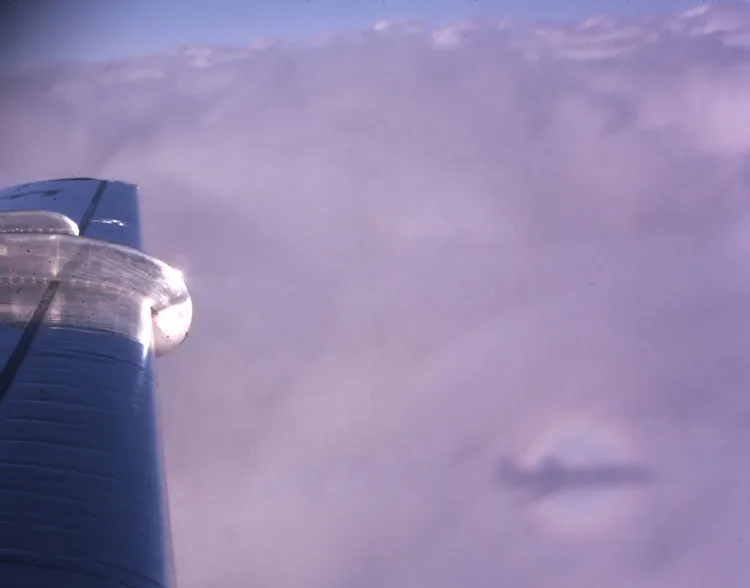
A glory around the shadow of a Caravelle airliner on cloud over France in 1968, according to the image's file record. The camera rode in that plane, so the rings center on the plane's shadow.
"Brocken spectre seen from a Caravelle aircraft over France" by Adrian Pingstone — https://commons.wikimedia.org/wiki/File:Brocken.spectre.arp.750pix.jpg — Public domain (US and EU: released into the public domain worldwide by the photographer, Adrian Pingstone, as stated on the Commons file page)
A glory needs a water cloud below the viewer. Which kind of cloud that is falls under the types of clouds. The reading altitude for both effects is a view down onto that cloud with the Sun at your back, usually a low Sun when the view is from a mountain.
Why do the rings circle only your own shadow?
Three entries in the AMS Glossary set up the answer. The antisolar point lies on the line from the Sun through the viewer, and the glory entry says the rings surround that point, adding that the viewer's shadow matters only as a quick way to find it. The cloudbow entry names the antisolar point outright as the shadow of the viewer's head.
It follows that each person has a separate antisolar point. Sunlight arrives along parallel lines, so two people standing a few steps apart throw two head shadows a few steps apart on the cloud, and each person's line from the Sun ends on their own. Each viewer therefore sees the rings centered on their own shadow's head, while the other shadow sits off to one side, away from the center of the rings. This is a reading of the geometry, not a separate measurement.
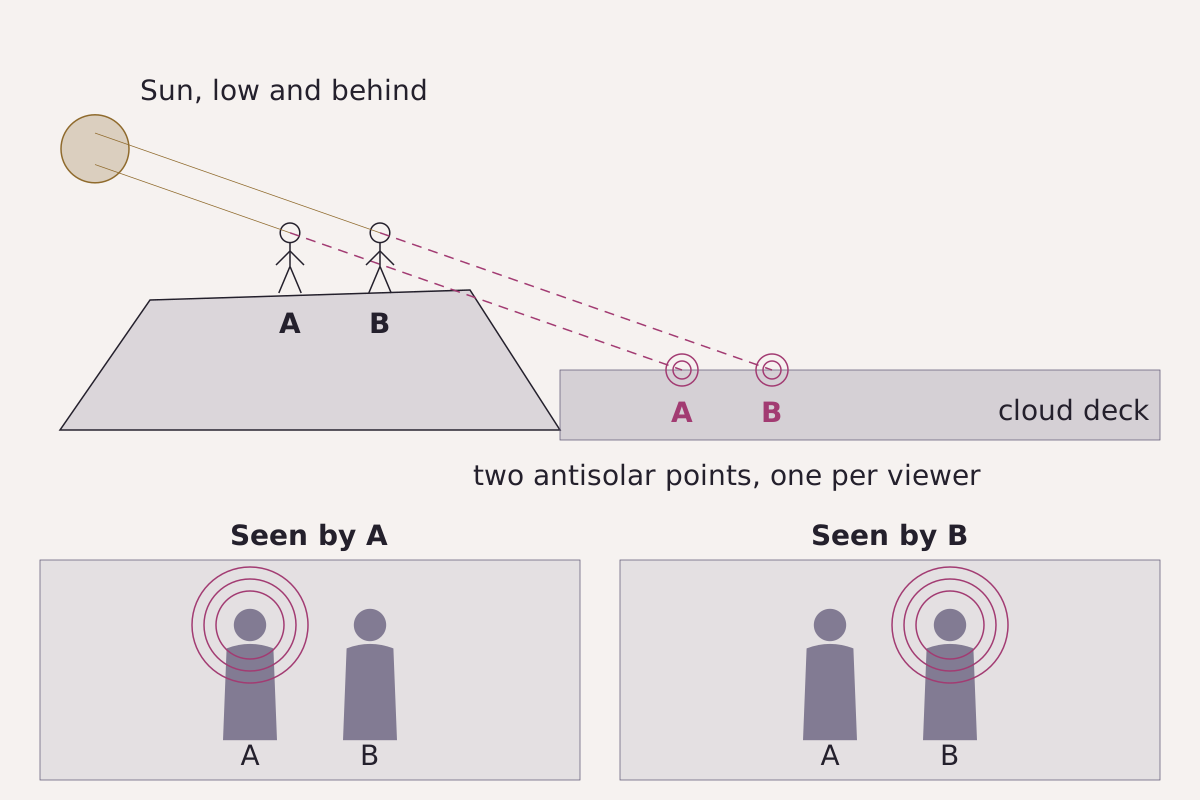
Two viewers, two antisolar points. The line from the Sun through each head ends on that person's own shadow, so each sees the rings centered on a different head.
Benchmark Schematic, not to scale; each antisolar point placed on the line from the Sun through one viewer's head, following the AMS Glossary definition; ring sizes not drawn to any angle.
"Two viewers, two antisolar points: why each glory circles its own shadow" by Meridian & Moraine, https://meridianandmoraine.com/aloft/brocken-spectre/, licensed under CC BY 4.0 (https://creativecommons.org/licenses/by/4.0/).
Data: Definitions from the AMS Glossary of Meteorology (antisolar point, glory, cloudbow), retrieved 2026-11-16
The same geometry explains where the colored light comes from. Light that reaches the eye from near the antisolar point has traveled almost straight back toward the Sun's side of the sky. The AMS Glossary calls scattering into the half of space the light came from backscatter, so by that definition a glory is sunlight that cloud droplets have scattered back toward its source.
The glory entry adds two details. Each ring's angular size is roughly inversely proportional to drop size, and glories form in droplets smaller than about 25 µm in radius. The entry also says simple theory does not easily account for the glory, so this page gives the rings no computed angles.
Why does the shadow look so huge?
The shadow itself is not large. The AMS Glossary entry for Brocken spectre says it is about the same size as the person, though the viewer sometimes gains the impression of a giant. The entry gives a likely reason: the eye compares the nearby shadow with distant objects glimpsed through the cloud.
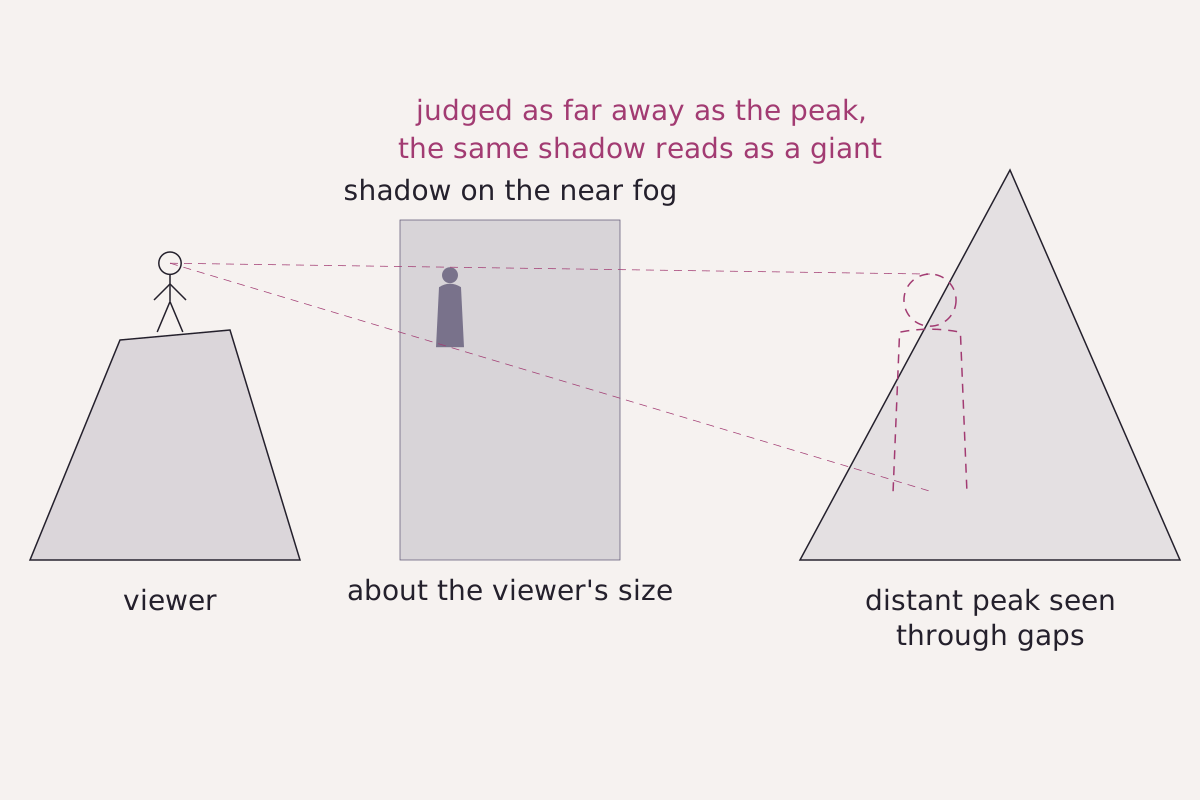
The shadow on the near fog is about the viewer's own size. Carried out to the distance of a far peak along the same sight lines, it would have to be a giant.
Benchmark Schematic, not to scale; the giant outline spans the same sight lines as the near shadow, following the comparison described in the AMS Glossary.
"Why a Brocken spectre looks giant: a near shadow judged as far away" by Meridian & Moraine, https://meridianandmoraine.com/aloft/brocken-spectre/, licensed under CC BY 4.0 (https://creativecommons.org/licenses/by/4.0/).
Data: Definition from the AMS Glossary of Meteorology (Brocken spectre), retrieved 2026-11-16
In that reading, a shadow on fog a short way off covers about the same patch of view as a much taller figure would at the distance of a far ridge. Placed out at that ridge, the figure has to be huge to fill the same patch. The engraving at the top of this page draws that impression: two giants towering over the people who cast them.
How is a glory different from a cloudbow or a heiligenschein?
Two other effects also center on the shadow of the viewer's head, and both can pass for a glory. The AMS Glossary describes a cloudbow, also called a fogbow, as a large, faintly colored arc on fog or cloud, broad and whitish, formed like a rainbow in smaller droplets. A heiligenschein, in the same glossary, is a diffuse bright region around the head's shadow on rough ground, clearest with a low Sun and dew on the grass.
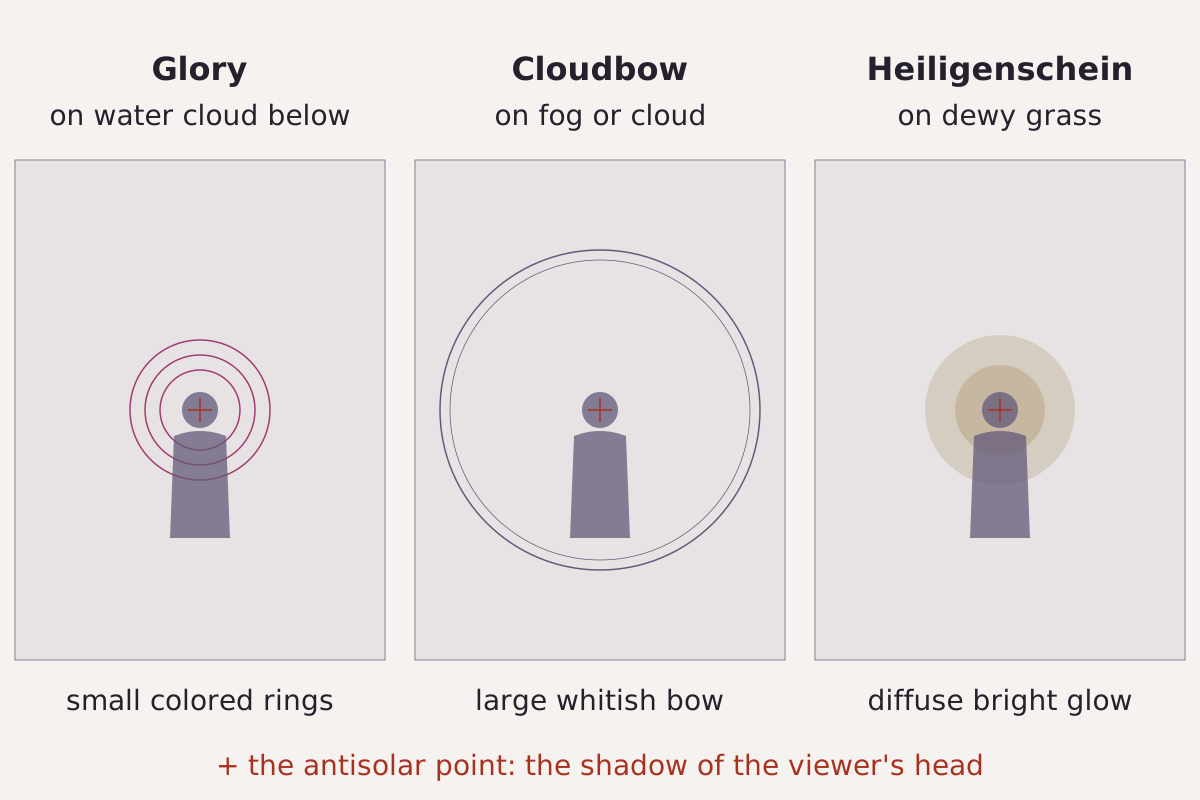
Three effects that center on the shadow of the viewer's head: a glory on a water cloud, a cloudbow on fog or cloud, and a heiligenschein on dewy grass.
Benchmark Schematic, not to scale; each effect centered on the antisolar point, as the AMS Glossary entries for glory, cloudbow and heiligenschein place it; no ring or bow drawn to any angle.
"Glory, cloudbow and heiligenschein around the shadow of the head" by Meridian & Moraine, https://meridianandmoraine.com/aloft/brocken-spectre/, licensed under CC BY 4.0 (https://creativecommons.org/licenses/by/4.0/).
Data: Definitions from the AMS Glossary of Meteorology (glory, cloudbow, heiligenschein), retrieved 2026-11-16
| Effect | Seen on | What it looks like | Centered on |
|---|---|---|---|
| Glory | A water cloud below the viewer | Small, faintly colored rings | The antisolar point |
| Cloudbow (fogbow) | Fog or cloud | A large, broad, whitish arc | The antisolar point |
| Heiligenschein | Dewy grass or other rough ground | A diffuse bright region | The shadow of the viewer's head |
Size and surface tell them apart. Small colored rings close around the head point to a glory, a wide pale arc far out from the head to a cloudbow, and a glow on the ground with no rings to a heiligenschein.
When the Sun is low behind you and cloud lies below, stay on a safe, level spot well back from any drop. Find the shadow of your own head first, then look for small rings close around it. If a friend is there, ask where their rings sit; by the geometry above, they should center on the friend's shadow, not yours.
Next overpass
- Double rainbow: another sight centered on the antisolar point, with a darker strip of sky between two bows.
- Von Kármán vortex street: a cloud deck seen from far above, where an island leaves a trail of swirls.
Sources
- American Meteorological Society, "Brocken spectre," Glossary of Meteorology. glossary.ametsoc.org/wiki/brocken-spectre/Read: glossary entry, paraphrased
- American Meteorological Society, "glory," Glossary of Meteorology. glossary.ametsoc.org/wiki/glory/Read: glossary entry, paraphrased; one short quotation
- American Meteorological Society, "antisolar point," Glossary of Meteorology. glossary.ametsoc.org/wiki/antisolar-point/Read: glossary entry, paraphrased
- American Meteorological Society, "backscatter," Glossary of Meteorology. glossary.ametsoc.org/wiki/backscatter/Read: glossary entry, paraphrased
- American Meteorological Society, "cloudbow," Glossary of Meteorology. glossary.ametsoc.org/wiki/cloudbow/Read: glossary entry, paraphrased
- American Meteorological Society, "heiligenschein," Glossary of Meteorology. glossary.ametsoc.org/wiki/heiligenschein/Read: glossary entry, paraphrased
Cite this page
The Reading Room. “Brocken Spectre: The Rings Center on Your Own Shadow’s Head.” Meridian & Moraine, published 16 November 2026. https://meridianandmoraine.com/aloft/brocken-spectre/. Accessed on the date you read it.
How readings are checkedAll correctionsReport an error on this page (contact@meridianandmoraine.com)
More from Sky Reading
Sky Reading
Types of Clouds: Why ‘High’ Clouds Sit Lower Near the Poles
Image credit
"Cumulonimbus anvil, NOAA Photo Library image nssl0035" by NOAA Photo Library, NOAA Central Library; OAR/ERL/National Severe Storms Laboratory (NSSL) — https://commons.wikimedia.org/wiki/File:Cumulonimbus_cloud_-_NOAA.jpg — Public domain (US: U.S. Government work, made by a NOAA employee as part of official duties (17 U.S.C. §105))
Sky Reading
Double Rainbow: Why the Sky Between the Bows Is Darker
Image credit
"Double-Rainbow.jpg" by LeonardoWeiss — https://commons.wikimedia.org/wiki/File:Double-Rainbow.jpg — CC BY 3.0 (https://creativecommons.org/licenses/by/3.0/)
 Illustration
Sky Reading
Lenticular Clouds: Most Mark the Crest of a Mountain Wave
Image credit (illustration)
Illustration: Meridian & Moraine. Generated illustration — not a photograph, satellite image or map; not to scale. Reuse: CC BY 4.0 (https://creativecommons.org/licenses/by/4.0/) to the extent any rights apply.