Double Rainbow: Why the Sky Between the Bows Is Darker
The Reading Room Published
Short answer
In a simple ray model, the strip between the bows is darker because raindrops send once-reflected light only inside the inner bow and twice-reflected light only outside the outer bow, so the gap gets neither.
Viewing card
- Where
- The half of the sky facing away from the Sun, where rain is falling in sunshine; the photo on this page was taken at Karlsruhe, Germany
- Seen from
- From the ground, facing the rain with the Sun behind you
- Captured
- Photo 22 July 2011; angles from a single-drop ray model, 404.7-656.3 nm, refractive index 1.3311-1.3429 (assumed)
- Reading altitude
- Field of view: the sky out to about 54° around the antisolar point, back to the Sun; in this page's model the outer edge of the secondary bow is at 53.45° (404.7 nm)
- Written by
- Sunlight bent into raindrops and reflected once inside them for the inner bow and twice for the outer bow, as Descartes described it in 1637; this page's ray model puts the two bows about 42.1° and 50.9° from the antisolar point (589.3 nm)
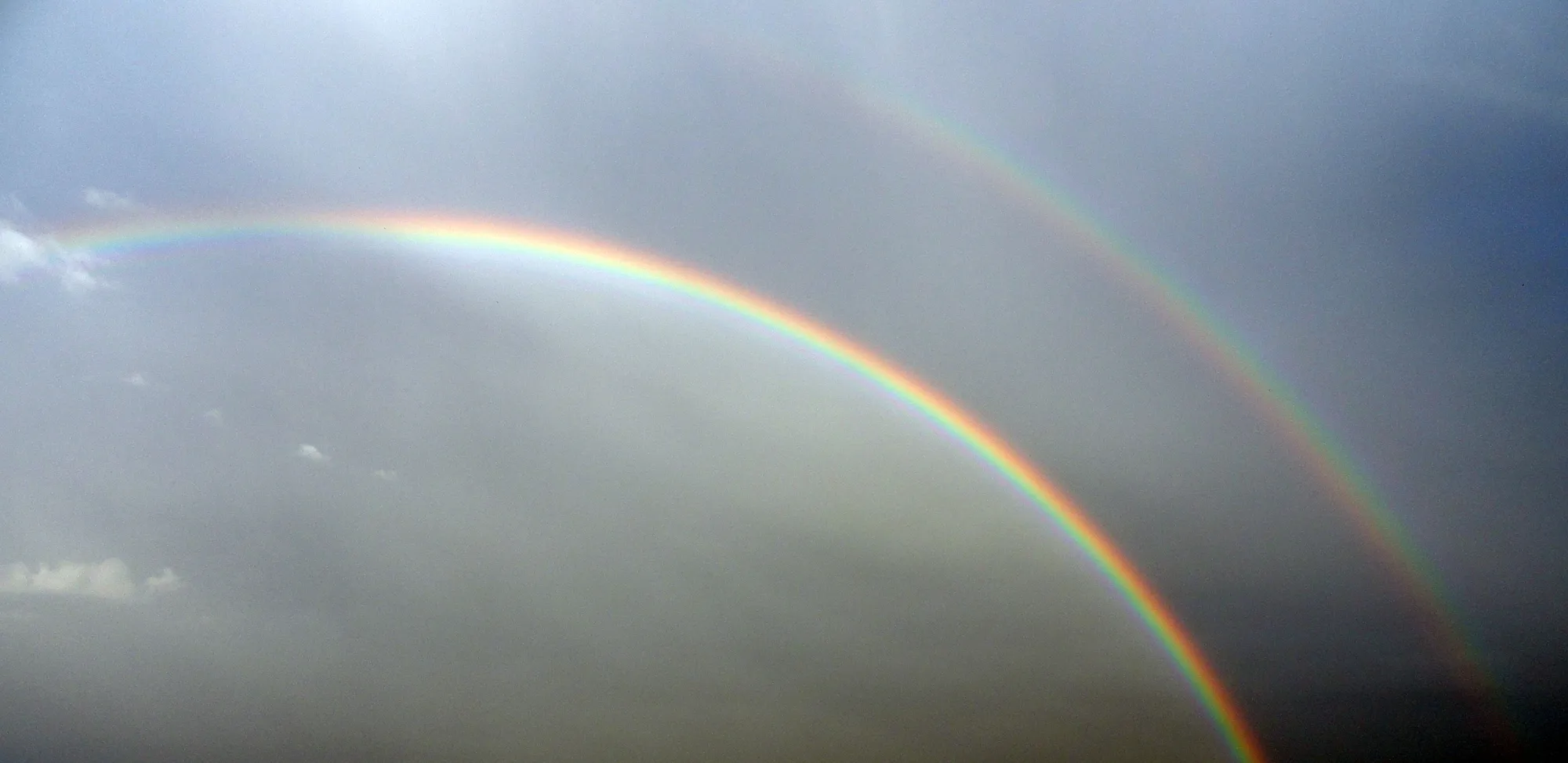
A double rainbow over Karlsruhe, Germany, on 22 July 2011. The sky inside the inner bow is lighter than the band between the bows.
"Double-Rainbow.jpg" by LeonardoWeiss — https://commons.wikimedia.org/wiki/File:Double-Rainbow.jpg — CC BY 3.0 (https://creativecommons.org/licenses/by/3.0/)
Look outside a bright rainbow and you may find a second, wider bow. Its colors run the other way, with red on the inside edge, as the American Meteorological Society's Glossary of Meteorology describes it. The glossary places both bows around the antisolar point, the spot directly opposite the Sun, with the outer one about 50° to 54° from the antisolar point. Between the two bows lies a darker strip of sky, named Alexander's dark band.
According to the AMS glossary, the band is named after Alexander of Aphrodisias, head of the Lyceum from 198 to 211 A.D., the first person known to have commented on it. The glossary names the band and places it but leaves out its cause. Geometry can supply that, and the figures below work it out with a model of a single raindrop.
Why is the sky between the bows darker?
Think of a raindrop as a small glass ball. Sunlight bends on the way in, bounces off the back of the drop, and bends again on the way out. The AMS primary rainbow entry gives the inner bow one internal reflection and the outer bow two.
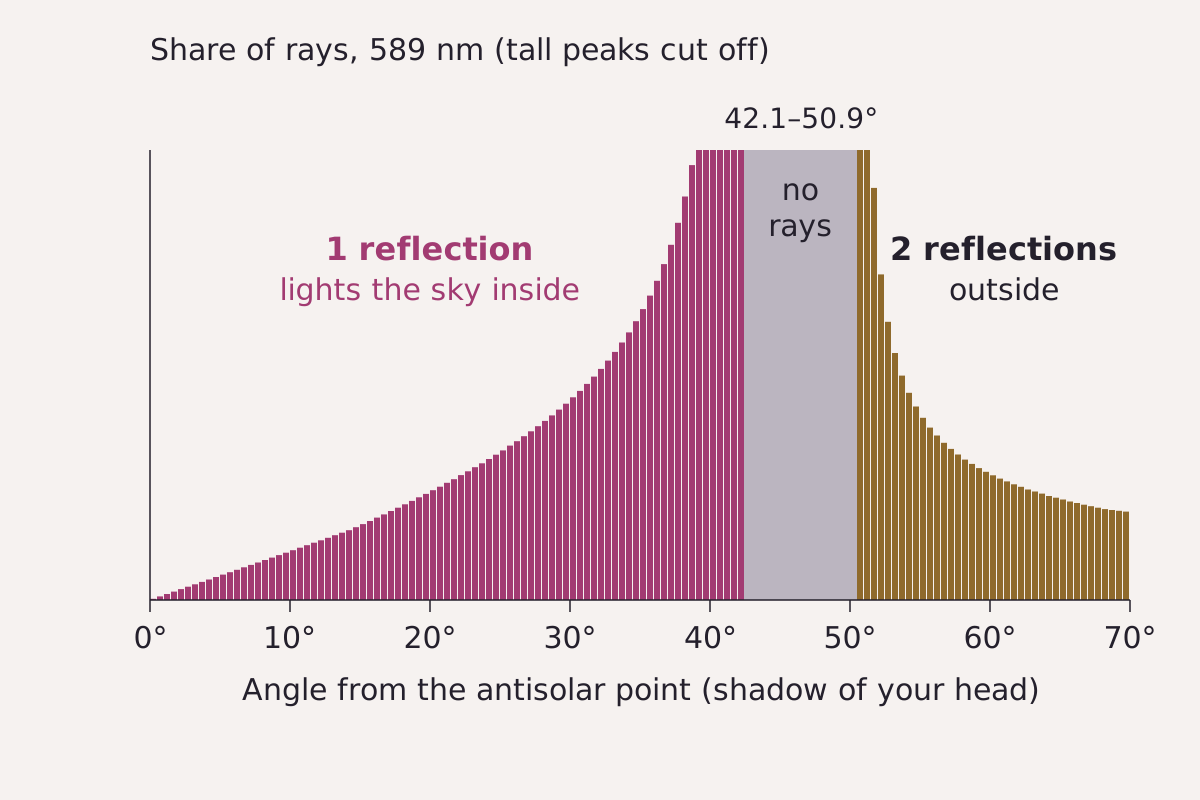
Where the light lands, for yellow light at 589 nm in a single-drop ray model. Light reflected once fills the sky within about 42.1° of the antisolar point; light reflected twice starts about 50.9° from the antisolar point and spreads outward. No ray of either kind reaches the band between.
Benchmark Angles computed from a single-drop refraction model at 589.3 nm, refractive index 1.3330 (assumed), 200,000 rays per bow; bow edges within 0.5° of published values.
"Light from one and two internal reflections by angle from the antisolar point, single-drop model" by Meridian & Moraine, https://meridianandmoraine.com/aloft/double-rainbow/, licensed under CC BY 4.0 (https://creativecommons.org/licenses/by/4.0/).
In the model, rays enter the drop at every height from dead center to the edge, and each height sends light back at its own angle. With one internal reflection, every ray comes out at less than about 42° from the antisolar point. The rays pile up near that limit. The pile-up is the bright primary bow, while rays that come out at smaller angles light the whole disk of sky inside it.
Twice-reflected light does the reverse. Every such ray comes out at more than about 51° from the antisolar point, and it too piles up at its limit, which is the secondary bow. Between about 42° and 51° from the antisolar point, the model sends neither kind of light.
That band is lit only by whatever else is in the sky, so it reads as darker. The photo shows the same pattern: a pale sky under the inner arch and a duller band above it.
The model is only a sketch. The AMS rainbow entry notes that ray theories explain the rough place and colors of the two bows but miss finer features, which depend on the wave nature of light and on the sizes and shapes of the drops.
Why does the outer bow run its colors backward?
The primary bow has red on the outside and blue on the inside, per the AMS primary rainbow entry. The secondary bow has reds to the inside, closest to the primary bow. A common explanation says that the extra bounce, on its own, turns the colors around. The AMS secondary rainbow entry calls that idea incorrect: it is “sometimes incorrectly asserted that the extra reflection, by itself, is responsible for the reversal of colors.”
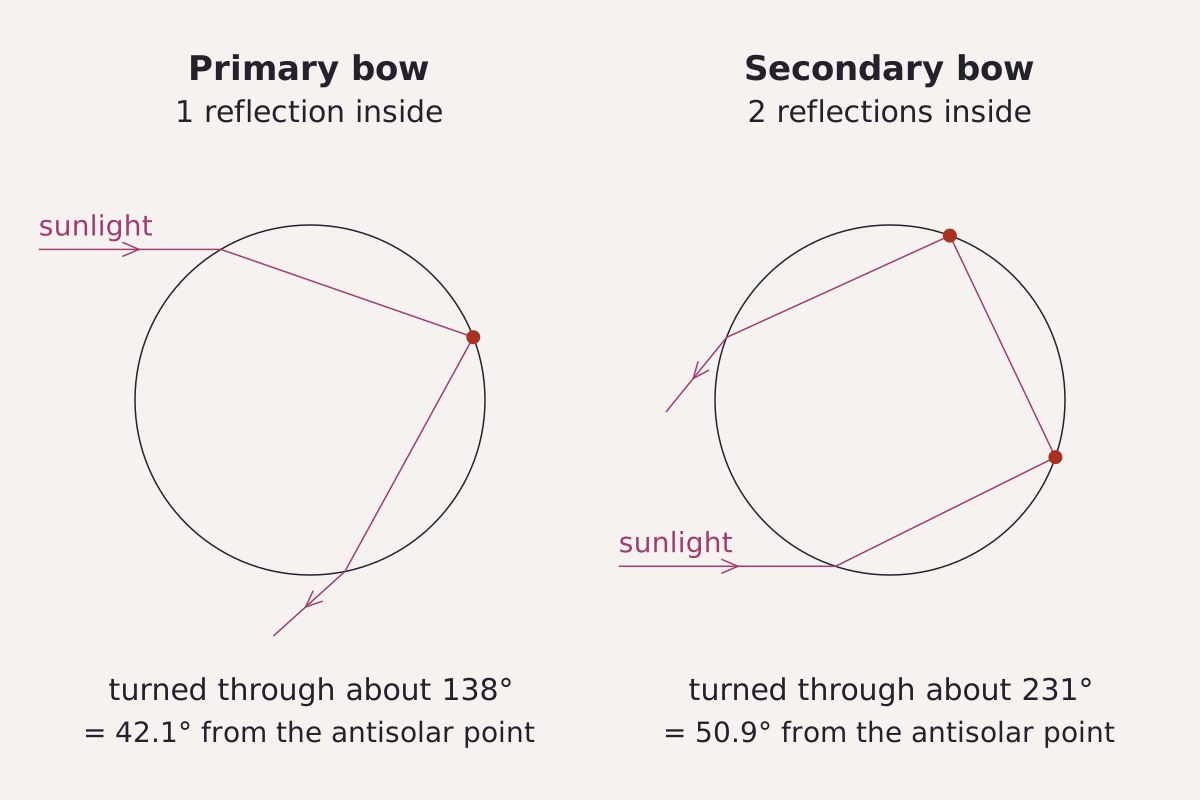
Paths of the ray that sets each bow's edge, for 589 nm light. In the first drop, the light is turned through about 138°; in the second, through about 231°.
Benchmark Ray paths computed from a single-drop refraction model at 589.3 nm, refractive index 1.3330 (assumed), each traced at the angle of least turning.
"Ray paths through a water drop for the primary and secondary rainbow, single-drop model" by Meridian & Moraine, https://meridianandmoraine.com/aloft/double-rainbow/, licensed under CC BY 4.0 (https://creativecommons.org/licenses/by/4.0/).
The model points to geometry instead. Water bends red light a little less than blue, so in both bows red is turned through the smallest angle. For one reflection, the turn is less than a half circle, about 137.6° for red against 139.3° for violet. The angle from the antisolar point is what is left of the half circle, so red ends up farthest out.
For two reflections, the turn is more than a half circle, about 230.4° for red against 233.5° for violet. Now the angle from the antisolar point is the amount past the half circle, so red ends up closest in. The rule for red holds in both drops; only the side of the half-circle mark where the light lands changes.
How far out does each bow sit?
The AMS glossary gives the primary bow at about 40° to 42° from the antisolar point and the secondary bow at about 50° to 54°. The model here recomputes those numbers at five spectral lines, from violet at 404.7 nm to red at 656.3 nm.
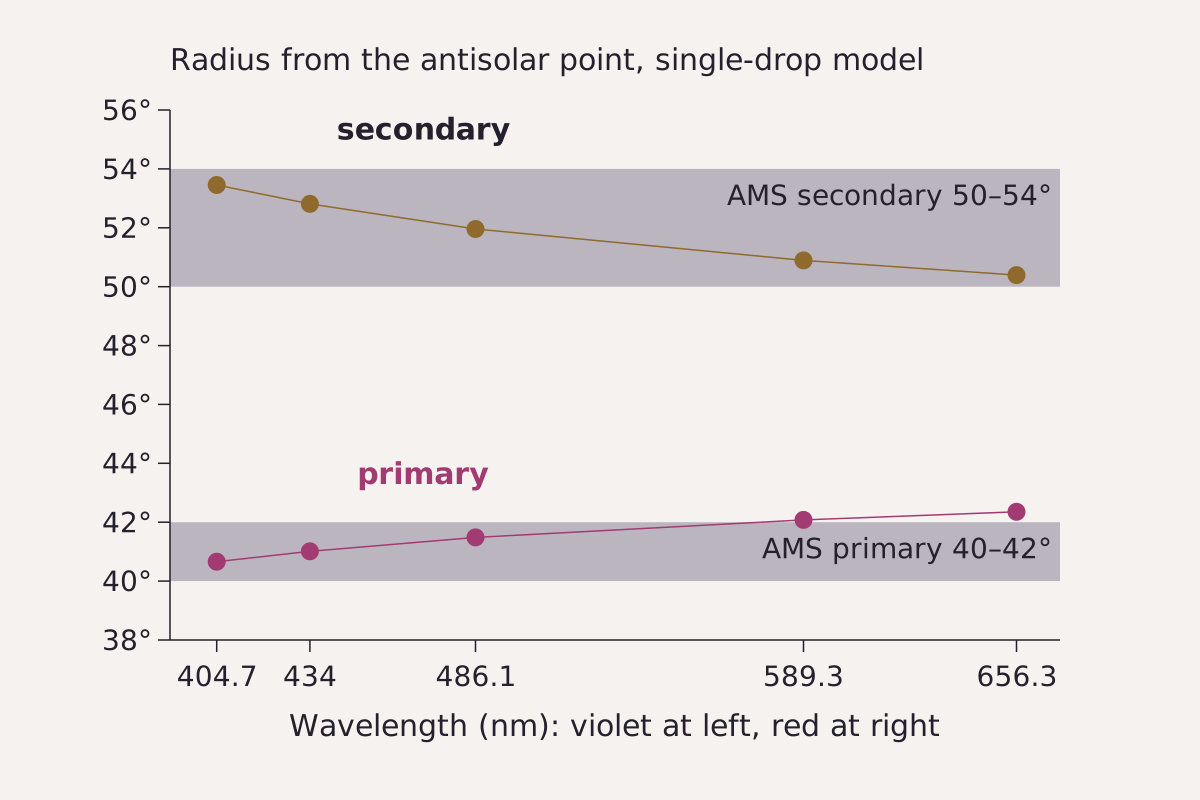
Radius of each bow from the antisolar point at five wavelengths, in a single-drop ray model. The shaded bands are the ranges in the AMS glossary.
Benchmark Angles computed from a single-drop refraction model; refractive index 1.3311–1.3429 (assumed); every value within 0.5° of the AMS ranges.
"Rainbow radii by wavelength, single-drop model" by Meridian & Moraine, https://meridianandmoraine.com/aloft/double-rainbow/, licensed under CC BY 4.0 (https://creativecommons.org/licenses/by/4.0/).
| Wavelength (nm) | Refractive index (assumed) | Primary bow, from antisolar point | Secondary bow, from antisolar point |
|---|---|---|---|
| 656.3 (red) | 1.3311 | 42.36° | 50.39° |
| 589.3 (yellow) | 1.3330 | 42.08° | 50.89° |
| 486.1 (blue-green) | 1.3371 | 41.49° | 51.96° |
| 434.0 (blue) | 1.3404 | 41.01° | 52.81° |
| 404.7 (violet) | 1.3429 | 40.66° | 53.45° |
Download the bow radii (CSV) (about this file)
Every secondary value lands inside the AMS range of 50° to 54° from the antisolar point. The red primary value, 42.36° from the antisolar point, sits 0.36° past the AMS figure, inside the half-degree limit this site sets for any computed angle.
The red edges of the two bows sit about 8.0° apart in the model, close to the AMS note that the secondary bow lies about 8° outside the primary. The model treats the Sun as a point, so real bows are a little wider and softer at the edges.
What did Descartes work out?
René Descartes set out this ray picture of the rainbow in Les Météores, an essay printed with his Discours de la méthode at Leiden in 1637. It is one of the earliest readable records of the two-bow explanation that this page could check against page images.
His woodcut on page 253 shows a large drop high in the sky, sunlight entering from the left, and an observer at E. A straight line, E M, runs from the eye toward the antisolar point. On page 252 he puts bright red at about 42° from E M, the antisolar line, and a fainter red at about 52°.
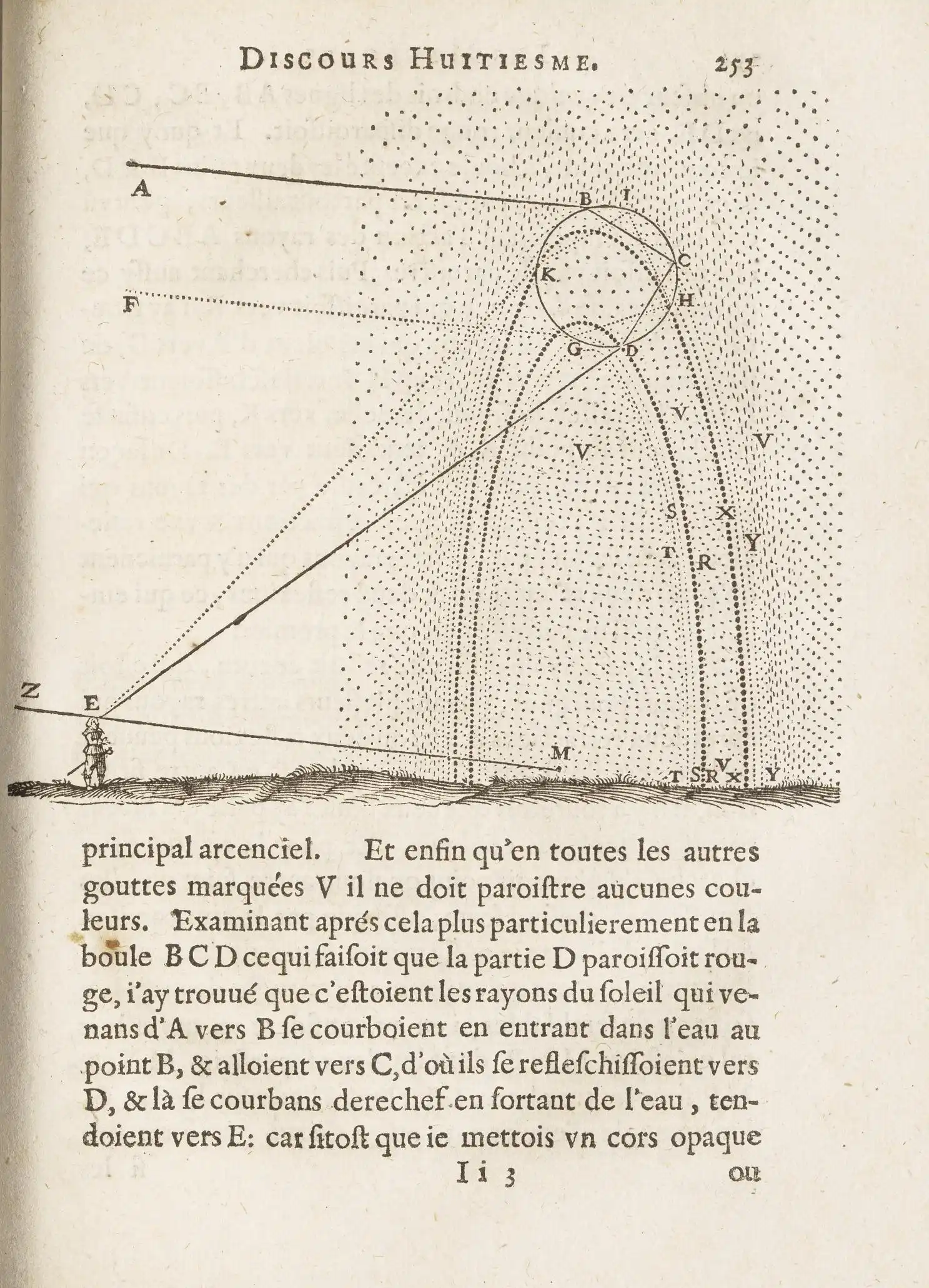
Page 253 of Descartes's Les Météores (1637): sunlight enters the large drop from the left, and an observer stands at E, with the line E M running toward the antisolar point.
"Page 253, from Les Météores (Discours de la méthode, 1637)" by René Descartes — https://archive.org/details/discoursdelamet00desca/page/n336 — Public domain (US: first published 1637 (Leiden: Ian Maire); EU: author René Descartes died 1650, and the woodcut is unsigned, published 1637, more than 70 years ago)
On page 254 he writes that the first rainbow comes from rays that reach the eye “aprés deux refractions & vne reflexion,” after two refractions and one reflection, and the second from rays that arrive after two refractions and two reflections.
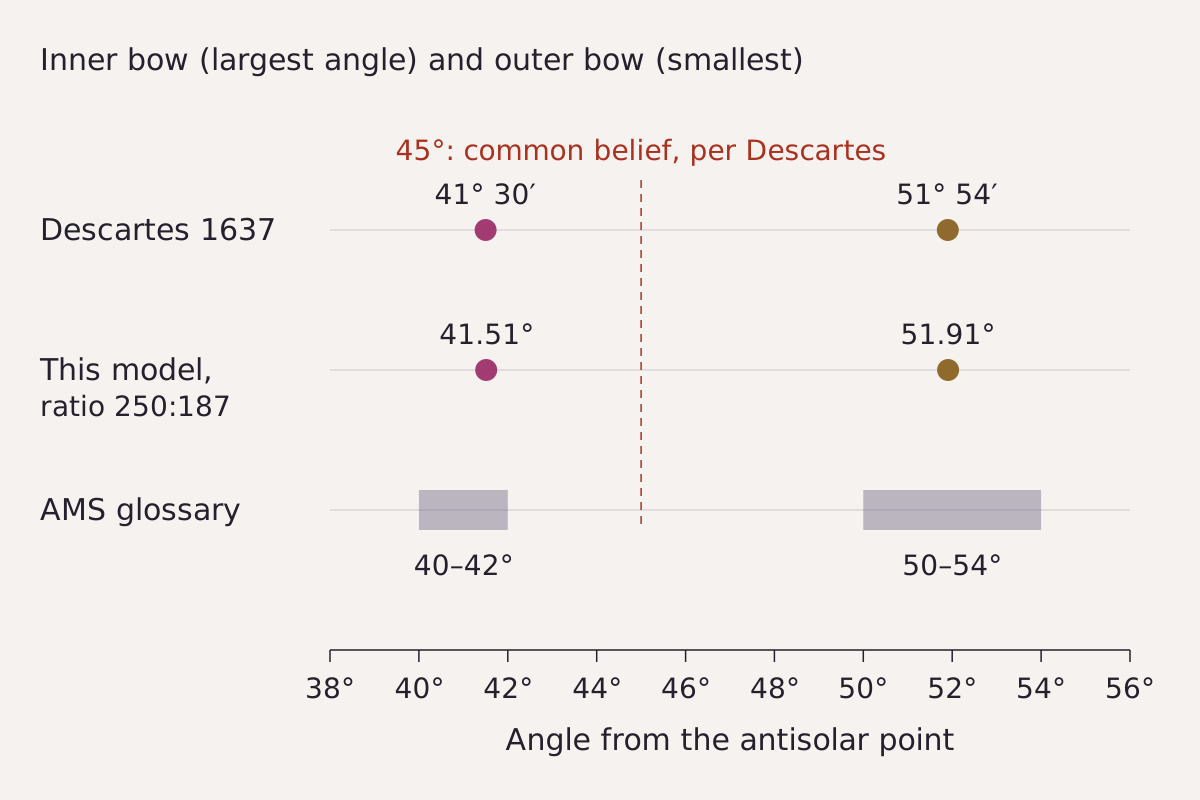
Descartes's 1637 angles for the inner and outer bow, the same angles from this page's model using his refraction ratio, and the AMS ranges, all measured from the antisolar point. The dashed line marks the 45° that, he wrote, common belief gave the inner bow.
Benchmark Descartes's values read from page 266 of the 1637 edition; model angles computed from a single-drop refraction model with refractive index 250/187; AMS ranges from the glossary entries.
"Rainbow angles: Descartes 1637, this model with his refraction ratio, and the AMS ranges" by Meridian & Moraine, https://meridianandmoraine.com/aloft/double-rainbow/, licensed under CC BY 4.0 (https://creativecommons.org/licenses/by/4.0/).
Later in the same discourse, he gives water's refraction as “comme de 187 a 250,” as 187 to 250 (p. 263). From that he works out the largest angle for the inner bow as 41° 30′ from the antisolar line, and the smallest for the outer bow as 51° 54′ (p. 266). Allowing about 17′ for the Sun's half-width, he then gives 41° 47′ and 51° 37′ from the antisolar line.
Run with his ratio of 250 to 187, the model on this page gives 41.51° and 51.91° from the antisolar point. Those land within a minute of his figures before the Sun's half-width was added.
Where do you look for the second bow?
Turn your back to the Sun and find the shadow of your own head, which marks the antisolar point. The AMS rainbow entry notes that the bows are normally centered on it, so each person sees a slightly different bow.
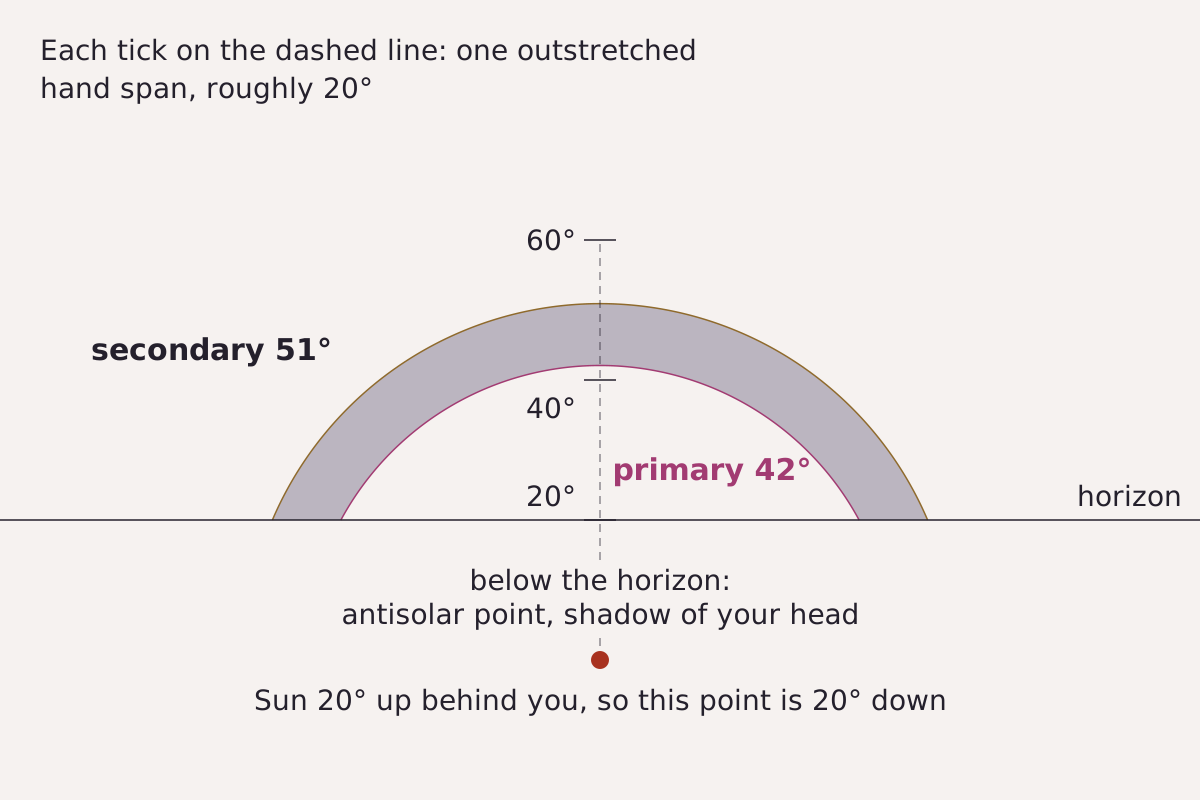
Where to look, with the Sun 20° up behind the viewer. The antisolar point lies 20° below the horizon, and only the upper parts of the two circles show.
Benchmark Schematic; bow radii from the single-drop refraction model at 589.3 nm; one hand span drawn as about 20°.
"Where to look for the two bows, with hand-span ticks" by Meridian & Moraine, https://meridianandmoraine.com/aloft/double-rainbow/, licensed under CC BY 4.0 (https://creativecommons.org/licenses/by/4.0/).
The U.S. National Park Service gives a rough guide for angles in the sky. Held at arm's length, a fist covers about 10°, and a hand span with the fingers spread covers about 20°. By that guide, the primary bow sits roughly two hand spans from the antisolar point, and the secondary bow roughly two and a half. Hands and arms differ, so these are rough guides, not measurements.
The Sun's height matters too. The antisolar point sits as far below the horizon as the Sun is above it, so a low Sun gives tall bows. In this model, with the Sun higher than about 42° above the horizon, the whole primary bow sits below the horizon of flat ground, because its radius around the antisolar point is about 42°.
The reading altitude for a double rainbow is therefore a field of view: the sky out to about 54° from the antisolar point, with your back to the Sun. To name the cloud that is dropping the rain, start with types of clouds. For another sky feature that only shows from the right spot, see lenticular clouds on the downwind side of a ridge.
How can you tell a second bow from a broken first one?
The AMS rainbow entry warns that two broken pieces of one bow are sometimes reported as two rainbows. The secondary bow can also go unseen: the AMS secondary rainbow entry says it is usually dimmer and may lack the contrast to stand out.
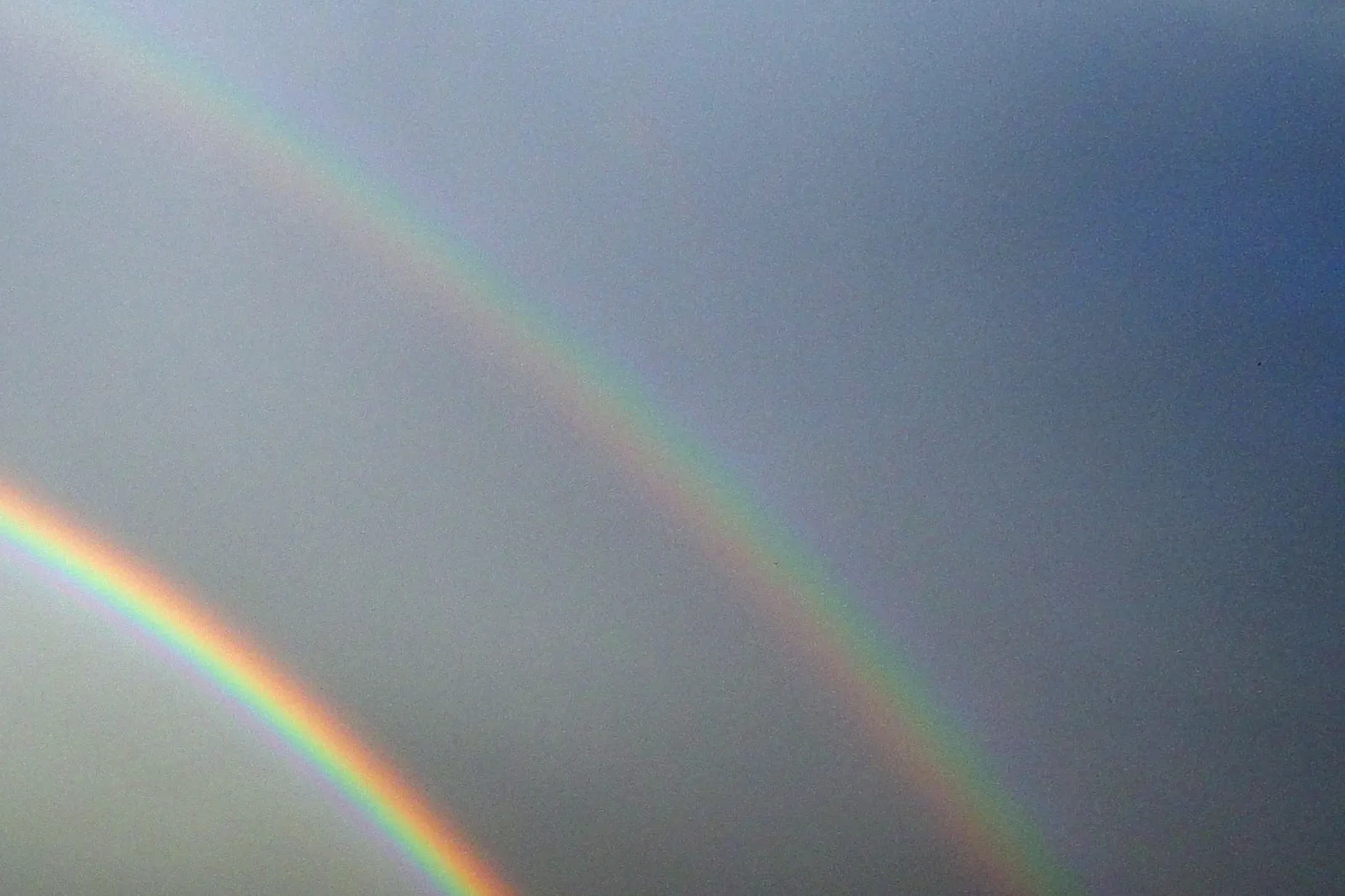
A closer crop of the Karlsruhe photo. Along the outer bow, red faces inward, toward the inner bow, and the band between the arcs is darker than the corner of sky inside the inner bow, at lower left.
"Double-Rainbow.jpg (detail)" by LeonardoWeiss — https://commons.wikimedia.org/wiki/File:Double-Rainbow.jpg — CC BY 3.0 (https://creativecommons.org/licenses/by/3.0/); modified: cropped
Is a double rainbow rare? On Meridian & Moraine, “rare” is a claim that needs evidence: where, in which season, and compared with what. None of the sources read for this page counts single bows against double bows for a stated place and period. So this page makes no claim about how often they occur.
Next time two arcs show in the rain, check three things before calling the outer one a secondary bow. Its colors should run with red on the inside. It should sit outside the first arc by roughly half a hand span. And the strip of sky between the two should look darker than the sky inside the inner bow.
Next overpass
- Brocken spectre: rings that also circle the antisolar point, but only around the shadow of your own head.
- Shaded relief: the side the light comes from can make a valley read as a ridge.
Sources
- American Meteorological Society, "secondary rainbow," Glossary of Meteorology. glossary.ametsoc.org/wiki/secondary-rainbow/Read: glossary entry, paraphrased; one short quotation
- American Meteorological Society, "primary rainbow," Glossary of Meteorology. glossary.ametsoc.org/wiki/primary-rainbow/Read: glossary entry, paraphrased
- American Meteorological Society, "rainbow," Glossary of Meteorology. glossary.ametsoc.org/wiki/rainbow/Read: glossary entry, paraphrased
- American Meteorological Society, "antisolar point," Glossary of Meteorology. glossary.ametsoc.org/wiki/antisolar-point/Read: glossary entry, paraphrased
- American Meteorological Society, "Alexander's dark band," Glossary of Meteorology. glossary.ametsoc.org/wiki/alexander-s-dark-band/Read: glossary entry, paraphrased
- René Descartes, Les Météores, in Discours de la méthode … Plus La dioptrique. Les météores. Et La géométrie (Leiden: Ian Maire, 1637), Discours huitième, "De l'arc-en-ciel". archive.org/details/discoursdelamet00descaRead: pages 252, 253, 254, 263 and 266, checked against the page images
- National Park Service, "Lewis and Clark used a sextant, you can use your hands!" Lewis and Clark National Historic Trail. www.nps.gov/articles/000/lewis-and-clark-used…Read: full text
Cite this page
The Reading Room. “Double Rainbow: Why the Sky Between the Bows Is Darker.” Meridian & Moraine, published 16 November 2026. https://meridianandmoraine.com/aloft/double-rainbow/. Accessed on the date you read it.
How readings are checkedAll correctionsReport an error on this page (contact@meridianandmoraine.com)
More from Sky Reading
Sky Reading
Types of Clouds: Why ‘High’ Clouds Sit Lower Near the Poles
Image credit
"Cumulonimbus anvil, NOAA Photo Library image nssl0035" by NOAA Photo Library, NOAA Central Library; OAR/ERL/National Severe Storms Laboratory (NSSL) — https://commons.wikimedia.org/wiki/File:Cumulonimbus_cloud_-_NOAA.jpg — Public domain (US: U.S. Government work, made by a NOAA employee as part of official duties (17 U.S.C. §105))
 Illustration
Sky Reading
Lenticular Clouds: Most Mark the Crest of a Mountain Wave
Image credit (illustration)
Illustration: Meridian & Moraine. Generated illustration — not a photograph, satellite image or map; not to scale. Reuse: CC BY 4.0 (https://creativecommons.org/licenses/by/4.0/) to the extent any rights apply.
Sky Reading
Brocken Spectre: The Rings Center on Your Own Shadow’s Head
Image credit
"Le Spectre du Brocken, fig. 84, from L'atmosphère: météorologie populaire" by Unknown author — https://commons.wikimedia.org/wiki/File:Flammarion_Le_Spectre_du_Brocken_.jpg — Public domain (US: first published 1888, before 1931; EU: anonymous engraving first published 1888, more than 70 years ago (engraver not named)); modified: resized